How is AI disrupting the world of cost engineering?
Cost engineering has long been considered the domain of experience, characterized by Excel spreadsheets, bottom-up calculations, and implicit knowledge. But the rules of the game are changing. Artificial intelligence is entering an area that was previously considered difficult to automate. What does this mean for industrial companies? And how are specialized AI providers such as PartSpace positioning themselves in this change? Two professors from applied research provide some insight.
For decades, a simple formula applied: if you want to calculate costs accurately, you need experience, time, and access to the right data. But this equation is beginning to falter. Artificial intelligence methods, including machine learning, pattern recognition, and geometric analysis, have long been technologically mature. But the real challenge lies elsewhere.
Prof. Dr. Dirk Hecht, program director for Digital Purchasing and Sustainable Supply Chain Management (SCM) at the Technical University of Ingolstadt, assesses the status quo: "AI in cost engineering is in an advanced transition phase, moving from exploratory individual applications to productive, integrated systems. The limiting factor is less the algorithms than data integration and organizational anchoring. "
For industrial companies, the question is no longer whether AI will arrive in cost engineering, but who will actively shape the transformation and who will merely react to it.
Why cost engineering is so susceptible to disruption
At first glance, cost engineering seems like a bastion of experiential knowledge - too complex, too context-dependent, too reliant on expert knowledge to be replaced by AI. But the opposite is true. Where complexity meets recurring decision patterns, ideal conditions arise for learning systems.
Prof. Dr. Dirk Weber, Professor of Strategic Procurement & SCM at Munich University of Applied Sciences, identifies the decisive factors: "Cost engineering combines several characteristics that make it particularly susceptible to AI-based disruption: high product and process complexity, highly fragmented and heterogeneous data sources, and considerable time and cost pressure when making decisions. At the same time, early decisions in the product development process have a disproportionately strong impact on overall costs." It is precisely this last point that makes AI so valuable: the earlier reliable cost data is available, the greater the scope for design – and the higher the potential savings.
The changing role of the cost engineer
With the advent of AI, many professionals are asking themselves: Will cost engineers become redundant? The answer is nuanced. Automation primarily affects tasks that have traditionally been time-consuming, such as data collection, classification, and initial cost estimates. But that's not the end of the story. Prof. Dr. Dirk Hecht sees a fundamental shift in the job profile: “The role of the cost engineer is primarily being transformed. At the same time, analytical, interpretative, and communicative skills are becoming increasingly important. The cost engineer is evolving from a calculator to a decision-maker who critically evaluates AI results, interprets scenarios, and communicates them internally and externally.”
In concrete terms, this means that the core competence is shifting away from manual data collection and calculation toward evaluation, classification, and decision-making. Cost engineers are becoming translators between technology and organization. Machines will not be able to take on this role in the foreseeable future.
CAD data as a new enabler
The key to the next stage of evolution lies in the design department. CAD data contains much more than just geometries. It describes manufacturing processes, tolerances, material requirements, and degrees of complexity. Those who can automatically read this information and link it to cost and supplier data gain a decisive advantage.
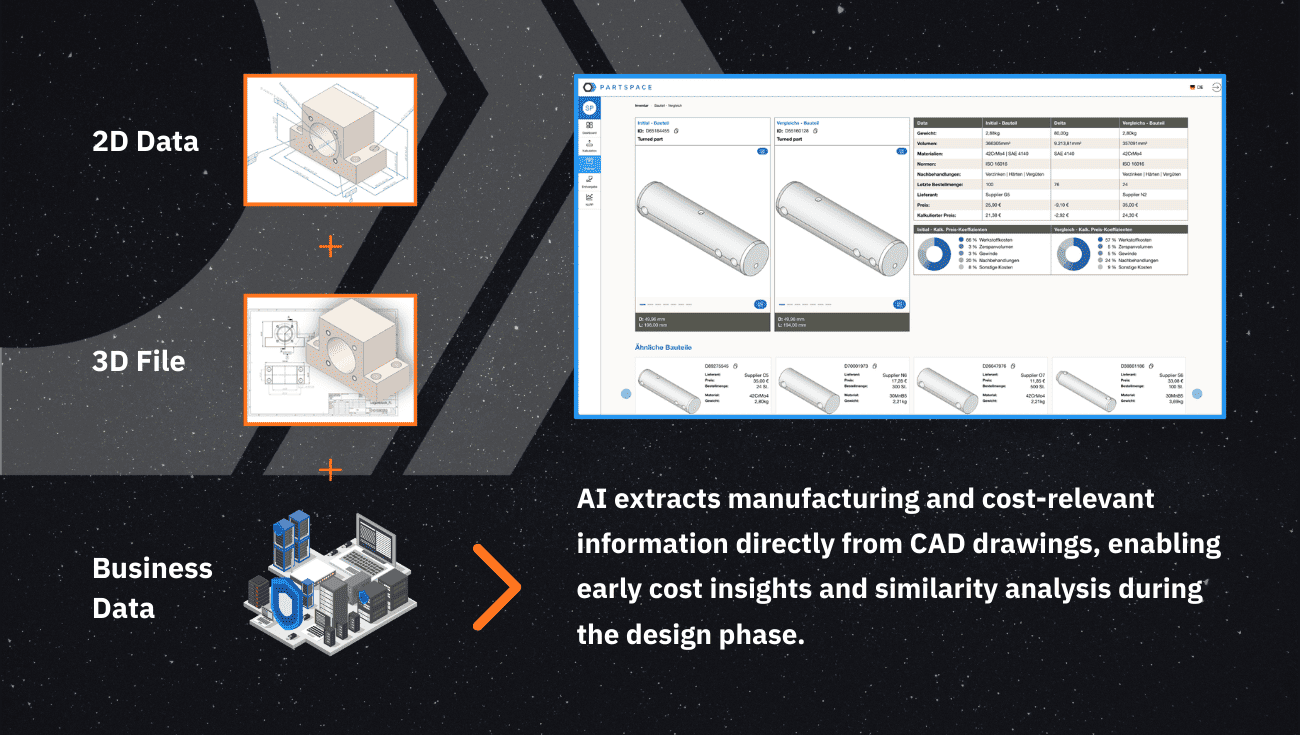
This is precisely where the potential lies. Cost estimates are no longer generated after construction, but during the design process. This fundamentally changes the logic. Cost engineering is transformed from a reactive evaluation function into an active control instrument that designers can use as early as the component design stage. This opens up new perspectives for companies with complex engineering processes. The technical drawing becomes the central data basis for informed procurement decisions.
What makes AI truly disruptive in cost engineering
Not every AI application changes the rules of the game. Real disruption occurs when technology goes beyond pure cost estimation and directly intervenes in decision-making processes. Three functionalities stand out in this regard: automated geometry and manufacturability analyses, learning models based on real manufacturing and quality data, and AI-supported supplier and process recommendations.
But forecasts alone are not enough. Industrial companies need transparency - especially when it comes to strategic cost decisions. Prof. Dr. Dirk Weber therefore emphasizes an often overlooked aspect: “The decisive factor is the combination of forecasting ability and explainable derivation of cost drivers.” This is what distinguishes industry-ready AI from generic approaches: it is not about black-box results, but about transparent recommendations for action that cost engineers and purchasers can use in negotiations and design decisions.
Outlook: From platform to infrastructure
AI in cost engineering does not work in isolation. Engineering receives cost feedback during the design phase. Purchasing gains a solid basis for argumentation. Quality managers can assess risks before they become costly. What previously took place in separate silos is now growing into a common basis for decision-making. But this is precisely where many in-house developments fail: Generic AI models do not understand design data. They can neither interpret geometries nor derive manufacturing processes. Specialized providers such as PartSpace therefore rely on models that have been trained on real CAD data, ERP information, and manufacturing plans. The difference lies not in the technology alone, but in the combination of data access and process understanding.
Looking ahead, it is clear that engineering, purchasing, and supply chain will become increasingly interlinked via specialized AI platforms. “AI tools such as PartSpace AI enable scalability, consistency, and transparency and are becoming a central component of strategic product and cost decisions,” says Prof. Dr. Dirk Weber. For industrial companies, this means that those who lay the groundwork today - data access, process integration, organizational acceptance - are positioning themselves for a future in which cost engineering is a strategic lever rather than a bottleneck.
About the experts:
Prof. Dr. Dirk Hecht is a subject advisor and program director for the master's program in Digital Purchasing and Sustainable Supply Chain Management, as well as dean of studies at the Institute for Academic Continuing Education (IAW) at Ingolstadt University of Applied Sciences. His research focuses on procurement management and business administration.
Prof. Dr. Dirk Weber teaches as a professor of Strategic Procurement & SCM with a focus on Cost & Value Engineering at Munich University of Applied Sciences. For more than 20 years, he has led international teams in the areas of operations, SCM, and procurement in both large Fortune 100 companies and small and medium-sized enterprises in the high-tech, healthcare, and energy industries.
Let's discuss how to solve your cost issues
Let's discuss how to solve your cost issues
Related Articles
How BHS Corrugated Reduced Procurement Costs with PartSpace AI
Discover how BHS Corrugated modernized technical procurement with PartSpace AI. Learn how AI-powered price validation, CAD analysis and supplier benchmarking helped reduce procurement costs and improve purchasing efficiency.
Cloud vs. On-Premises: Why AI Is Setting New Infrastructure Standards in Technical Procurement
AI is reshaping technical procurement — but scalable performance requires the right infrastructure. Learn why cloud-based AI platforms outperform traditional on-premises systems in CAD analysis, supplier intelligence, security, and operational scalability for modern manufacturing companies.
Agentic AI: Why most AI agents in technical procurement will fail
Agentic AI promises to transform technical procurement—but most implementations are set up to fail. The issue isn’t the capability of AI models like ChatGPT, but the absence of structured, integrated industrial data. Without a solid data foundation linking CAD, ERP, PLM, and supplier insights, AI agents remain impressive demos rather than reliable tools. This article explores why data—not algorithms—is the true bottleneck, and what companies must fix to unlock real value.